Material handling in a cleanroom involves more than moving a load from one location to another. Equipment must fit the facility’s operating procedures, support efficient workflows, and be suitable for the cleaning and environmental requirements of the space.
A cleanroom material handling lift can help operators pick up, raise, transfer, and position materials at different workstations. Choosing the right equipment requires more than checking its maximum load capacity. Here are the key factors to consider.
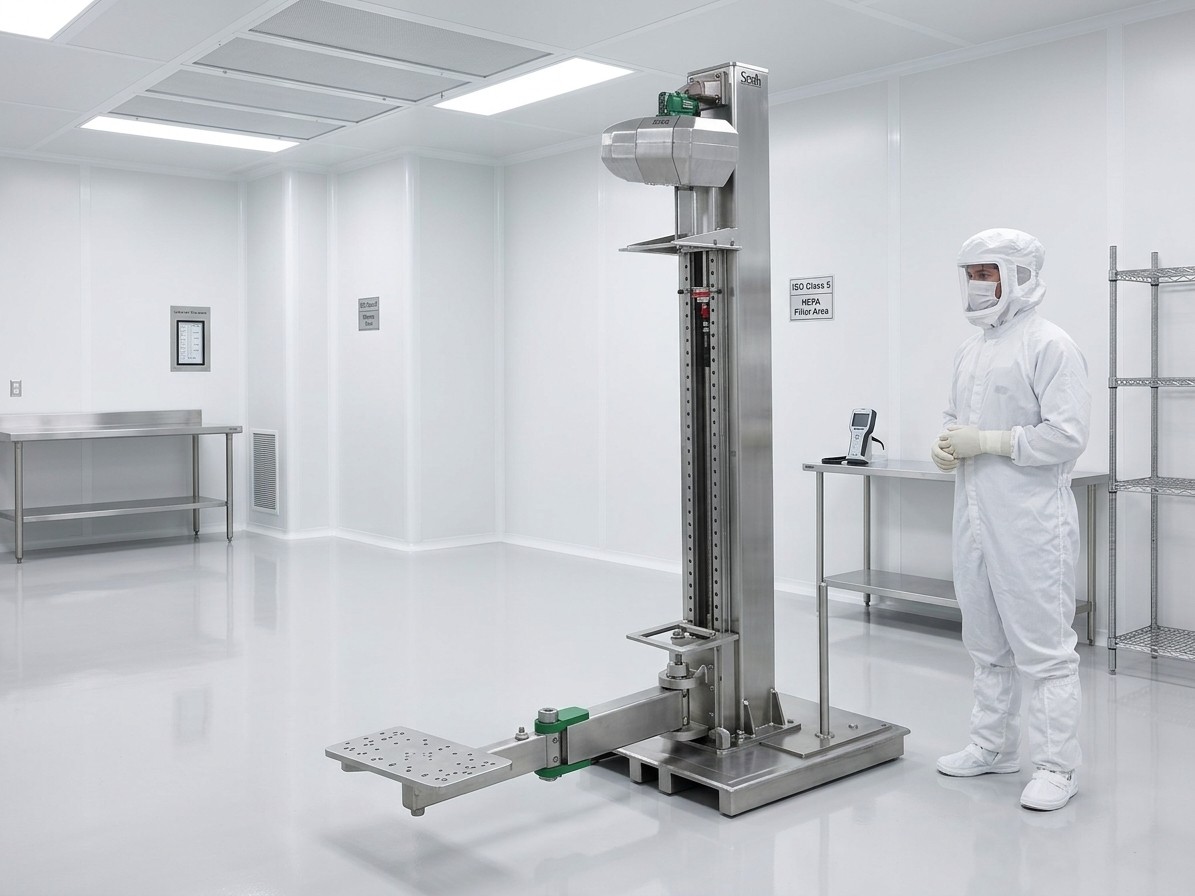
Stainless steel is the default material. AISI 304 suits most pharmaceutical and general cleanroom applications; AISI 316L offers superior resistance to chloride-based disinfectants and is preferred for sterile fill-finish suites and aggressive chemical environments. Painted or powder-coated surfaces are generally unsuitable—chipping releases particles and coatings can delaminate under repeated cleaning.
Surface finish matters beyond appearance. Electropolished surfaces with a roughness average (Ra) of 0.38 µm or lower resist bacterial adhesion and withstand repeated cleaning with IPA, hydrogen peroxide, or bleach-based agents. Smooth, crevice-free welds prevent particle entrapment.
Equipment must be designed for thorough cleaning without trapping contaminants. This means rounded corners, flush-mounted surfaces, and plugged fasteners rather than exposed threads or recessed cavities. Control panels should use sealed membrane switches; cable routing should be internal or flush-mounted. For washdown environments, IP65-rated electrical components provide dust-tight protection and water-jet resistance.
The lifting mechanism itself must minimize particle generation. Electric drives are strongly preferred over hydraulic systems, which carry an intrinsic risk of fluid leakage, vaporization, and seal degradation—all potential contamination events that also promote microbial growth. Belt hoists using high-strength fiber belts instead of chains or wire ropes eliminate metal-on-metal abrasion, a significant particulate source. Enclosed transmission structures and sealed bearings further reduce emission points.
For mobile units, cleanroom-rated non-marking casters with stainless steel frames are essential. Central braking and directional locks improve control in tight aisles. Electric mobile lifters eliminate cable trip hazards and hydraulic leak risks. Ergonomic controls—two-speed hand controls or wireless remotes—reduce operator fatigue during repetitive handling.
Criterion | ||
Best for | Materials moving between workstations, processing areas, and storage; | Dedicated workstations with consistent arrival height and location |
Flexibility | High—one unit serves multiple areas | Low—single location and task |
Cleanroom advantages | Stainless steel cleanroom mobile lifter enables inter-station transfer; | no trip hazards, easier cleaning |
Load & stroke | Limited by mobile weight/space constraints | Higher capacities and longer strokes without mobile constraints |
Typical use | Drums, crates, precision components; mobile lifting equipment for cleanroom offers adaptability fixed units cannot match | High-frequency transfer points needing consistent ergonomic height |
Limitations | Lower capacity ceiling; needs aisle space | No routing flexibility; may require floor modification |
Begin with the actual load, not the rated capacity. Consider the heaviest item the lift will handle, then add a safety margin. A filled 55-gallon drum weighs 400–600 lbs; a loaded 275-gallon IBC tote exceeds 2,400 lbs. Cleanroom mobile lifters in the 0–90 kg range handle light components and sample containers, while heavier-duty models reach 550 lbs or more for drum and reel handling.
Lift height must account for both the highest shelf or machine interface and the lowest pick point. Verify that the closed height allows the forks or attachment to reach beneath the load. Stroke length should provide adequate range without forcing the operator to overreach.
Platform size and attachment type should match load geometry. Fork attachments suit pallets and crates; drum grips handle cylindrical containers; custom cradles accommodate non-standard shapes. Modular tooling systems allow one lifter to serve multiple load types with quick-change attachments.
Before finalizing a specification, ask:
Is the lifting mechanism electric or hydraulic?If hydraulic, does it have sealed lines, drip containment, and secondary protection?
Electric is generally preferred for contamination-sensitive environments.
What stainless steel grade is used, and does it match the cleaning agents in use?
304 for standard cleaning; 316L where chloride-based disinfectants or corrosive agents are present.
What is the surface finish (Ra value)?
Electropolished surfaces below 0.38 µm are preferred for product-contact or high-hygiene areas.
Are casters and platform surfaces ESD-safe?
Required for electronics and semiconductor applications.
Does the lift fit the aisle width and turning radius of the cleanroom?
Compact profiles and appropriate maneuverability prevent workflow disruption.
At KUNFENG, we design and manufacture cleanroom lifting equipment engineered to the specific cleanliness class, load requirements, and layout constraints of your facility. Our cleanroom belt hoists and lifting systems use oil-free, low-particle technology suitable for ISO Class 5–8 environments. Whether you need a mobile unit for inter-station transfer or a fixed system for a dedicated workstation, our team can help you specify the right configuration. Contact KUNFENG today to discuss your cleanroom material handling requirements and request a customized solution.



